
Lets get straight to the point. Below are instructions on how you can create an iOS app without writing a single line of code.
Table of Contents
Step 1: Decide what your app does
Before you open any tool, write down your idea in plain language. Keep your first app very small. One core feature works better than five half‑built ones.
Step 2: Choose a builder
Here are strong options for building iOS apps without coding in 2026.
- FlutterFlow – Good for full‑featured iOS and Android apps with rich screens and logic.
- Adalo / Adalo‑style builders – Lets you create native iOS apps without writing code, using drag‑and‑drop components.
- PandaSuite – Drag‑and‑drop iOS app maker focused on interactive content such as guides, quizzes, and catalogs.
- Open as App – Turns spreadsheets into functional iOS apps quickly; good if your data lives in Excel or Google Sheets.
- Replit + AI Agent – Lets you describe an app in plain text, then generates and deploys it across iOS and web.
For this tutorial, we will use a generic “no‑code iOS app builder” model. The steps are similar across most tools.
Step 3: Sign up and create a new project
- Go to the website of your chosen no‑code app builder (FlutterFlow, Adalo, PandaSuite, etc.).
- Create an account with your email or Google sign‑in.
- Click “New project” or “Create app” and choose an iOS‑only or iOS‑and‑Android template.
- Pick a starter template if available (e.g., “To‑Do app”, “Quiz app”, “Directory”).
- Open the visual editor.
The editor will show:
- A screen canvas (phone‑like area).
- A left or right panel with components (buttons, text, images, lists).
- A top menu or toolbar with “Save”, “Preview”, and “Publish” options.
Step 4: Design your app screens
Use drag‑and‑drop to lay out each screen. For a simple app, you usually need 2–4 screens.
Example: Habit tracker app
- Home screen
- Drag a title text widget (e.g., “My Habits”).
- Add a list component below it.
- Add a floating “Add habit” button.
- Add habit screen
- Add a text input for the habit name.
- Add a date/time or frequency picker.
- Add a “Save” button.
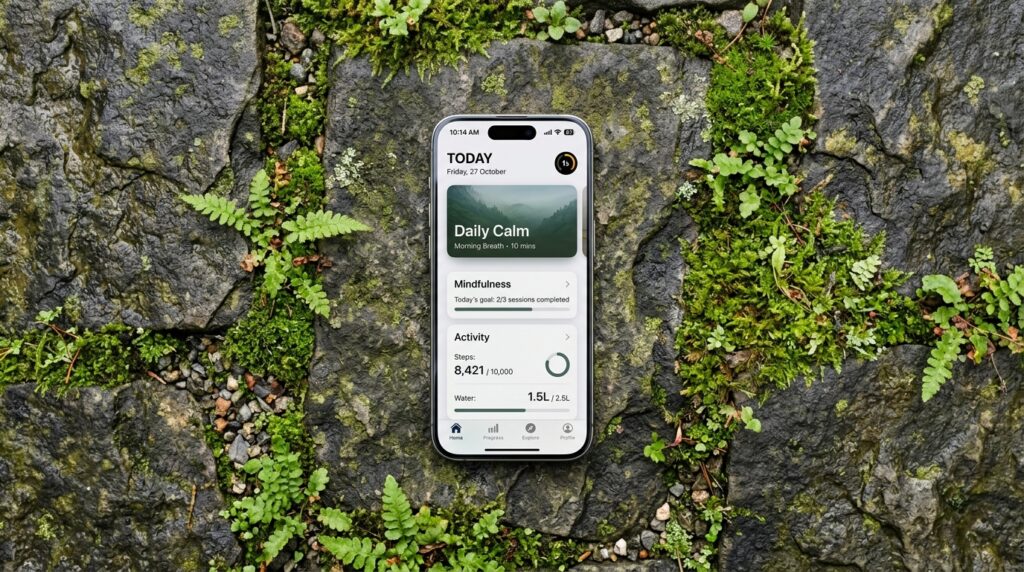
To place elements:
- Drag a button from the components panel onto the screen.
- Resize it by dragging its corners.
- Click the button and change its label to “Add habit” or “Start quiz”.
- Use the property panel to change color, font size, and corner radius.
Most tools support real‑time phone preview. You can open a viewer app on your iPhone or scan a QR code to see how your layout looks on a real device.
Step 5: Connect your data
No‑code apps store data in a built‑in database or spreadsheet. You do not need to touch SQL or Firebase directly.
Typical steps:
- Create a collection or table (e.g., “Habits” or “Businesses”).
- Add fields such as Name, Category, Date, Status, and Image.
- Link a list component on the screen to that table.
- When the user adds or edits data, the app automatically saves to the same table.
Example: connecting a habit list
- In the app builder, open the “Data” or “Database” section.
- Create a new table called “Habits” with fields: Name, Frequency, Completed.
- On the home screen, select the list component.
- In its settings, choose “Habits” as the data source.
- Map fields to how the list should display (e.g., Name → title text, Completed → checkmark).
When you add a habit on the second screen, set the action to “Save into Habits table” using the visual workflow builder.
Step 6: Add simple logic and actions
No‑code tools provide visual “actions” or “workflows” instead of if‑else statements. You can do things like:
- Go to another screen when a button is tapped.
- Check if a field is empty and show an error.
- Update a record when a user marks a habit as done.
Example: marking a habit done
- Select the checkmark icon in the habit list item.
- In the action panel, choose “Set field value”.
- Target the current habit’s “Completed” field and set it to
true. - Optionally, add a “Refresh list” action so the screen updates immediately.
Most tools let you add conditions. For example, “If Completed is true, show a green check; if false, show a gray circle”.
Step 7: Test on your iPhone
Before publishing, test your app on a real device.
Usual ways:
- Install the platform’s preview app (PandaSuite Viewer, FlutterFlow Preview, etc.).
- Open your project and click “Preview” or “Test on device”.
- Scan the QR code using your iPhone’s camera.
- Use the app like a real user would, checking buttons, lists, and back navigation.
If something breaks, go back to the editor and fix the action, data link, or layout. Then test again.
Step 8: Export or publish to the App Store
Most no‑code tools let you export an iOS‑ready app or help you publish it to the App Store.
General steps:
- Go to the Publish or Export section of your builder.
- Choose “iOS” or “iOS App Store” as the target.
- Upload an icon (512×512 PNG) and app screenshots (6.5‑inch, 5.5‑inch formats).
- Fill in basic info: app name, category, keywords, and description.
- Download the
.ipafile or let the platform send it directly to your Apple Developer account.
To publish to the App Store, you need:
- An Apple Developer account (paid, about 99 USD/year).
- A developer account is already set up in App Store Connect.
- Review by Apple (usually 1–3 days for simple apps).
Once approved, your app appears in the App Store under your developer name.
Step 9: Keep improving without code
After launch, you can still update your app without touching code:
- Adjust screen layouts in the editor.
- Add new fields to your database.
- Change colors, text, and buttons to match user feedback.
Many platforms let you update the app and push a new version to users via the App Store. You can even add analytics or simple tracking widgets to see which screens users visit most.
No-Code Tools Comparison
Popular no-code options for iOS development are:
| Platform | Best For | Drag and Drop App Builder | Database Options | Native iOS Features | Pricing Start |
|---|---|---|---|---|---|
| Adalo | Simple CRUD apps | Full visual | Built-in | Limited | $36/month |
| FlutterFlow | Feature-rich apps | Advanced | Supabase, Firebase | Extensive | $30/month |
| Thunkable | Quick prototypes | Basic | Built-in, Firebase | Moderate | Free tier |
| Glide | Data-first apps | Spreadsheet-style | Google Sheets | Basic | Free tier |
| Bubble | Complex logic | With a learning curve | Powerful built-in | Via plugins | $29/month |
FlutterFlow offers the most native iOS capabilities. Adalo hits a sweet spot for beginners.
Why No-Code Platforms Are Game-Changers
Here’s what makes a modern iOS app builder so powerful: you’re working with pre-built components that handle the complex stuff automatically. Database connections, user authentication, push notifications, these features that traditionally took weeks to code are now drag-and-drop elements.
The real game-changer is speed. What used to take months in traditional development can happen in days or weeks with no-code tools. You can test an idea, get user feedback, and iterate without burning through your budget on developer hours.
Leave a Reply